A summary of my class at the Tallinn teaching conference 14 August 2026
I was privileged to talk on the topic of discernment at the Tallinn teaching Conference this year. You can find the live recording here: https://www.youtube.com/live/PIy8qkw61wQ?si=i41ZNw2QjdFo-sHV&t=685. For those of you who would prefer a summary, I loaded my notes, the YouTube link and presentation images into Gemini notebook, edited the outcome, and this is the result. I hope you enjoy it, or at least find it useful. Please send me your feedback I would appreciate it.
Malcolm Cox, 19 August 2026

Introduction
I have come to realise that the most helpful Bible teachers are not necessarily those who know the most. Instead, they are the ones whose certainty is properly calibrated to the text and their audience. When I step forward to teach, I am reminded that my calling is to speak into the faith community with humility, courage, and love.
What is Discernment and Why Does It Matter?
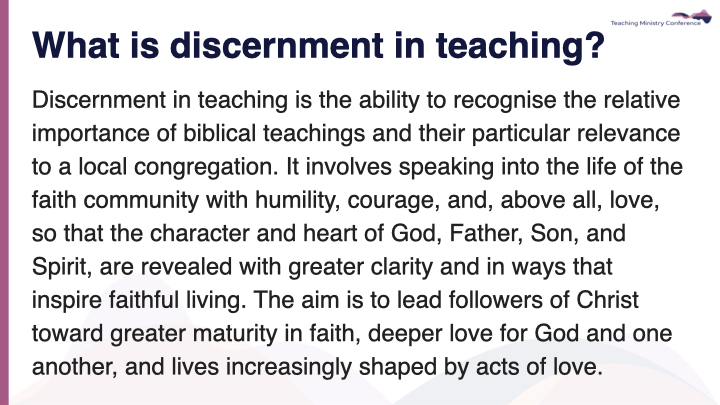
Discernment in teaching is the ability to recognize the relative importance of biblical teachings and their particular relevance to your local congregation. It isn’t just about knowing facts; it is about recognising what kind of issue you are addressing, how clearly Scripture speaks to it, and what weight it deserves. You will see this physically illustrated in the YouTube recording. I had three friends read Philippians 2:5-11. Two read with either no passion or far too much volume, while the third, Wendy, read with understanding and due care. Mature teaching sounds like that—a voice moderated to the message. “Thank you”, Wendy.
We see this expectation of discernment throughout the Word. Paul expected Timothy to be capable of it, telling him, “Think over what I say, for the Lord will give you understanding in all things” (2 Timothy 2:7). Similarly, the Jerusalem Council had to wisely apply principles to their unique context when they stated, “It seemed good to the Holy Spirit and to us not to burden you with anything beyond the following requirements” (Acts 15:28).
This matters because we carry an awesome responsibility. As James warns: “Not many of you should become teachers… for you know that we who teach will be judged with greater strictness” (James 3:1).
Avoiding the “Twin Ditches of Destruction”
Our goal as teachers is to stay on the narrow road, avoiding the “twin ditches of destruction”: over-simplification (having 100% confidence about everything) and over-caution (being vague about everything).

I learned the lesson of overconfidence the hard way when I was eight years old. I tried to impress my father—a Cambridge geography scholar—by making up a story about thunder being caused by clouds “banging together”. I dug a hole of false confidence I couldn’t get out of. We must lose the illusion that we need to appear “utterly confident” about every point. Paul described people who “want to be teachers of the law, but they do not know what they are talking about or what they so confidently affirm” (1 Timothy 1:3-7).
That said, there are things to be bold about! Peter was very confident that David was dead and buried (Acts 2:29) and that Jesus was raised. The key is calibration. We don’t want people leaving our sermons saying, “He almost said something”.

Why Do We Misuse Our Voice?
Sometimes we fall into these ditches because of:
- Laziness: It’s easier to keep the status quo and preach the same points we’ve used for 30 years rather than wrestling with nuance.
- People-Pleasing: The pressure to please others can shift our balance. Think of the prophet Hananiah, who made people “trust in a lie” and faced severe judgment (Jeremiah 28:15-17). Contrast that with Micaiah, who stood up to the King of Israel when the King complained, “I hate him, for he never prophesies anything favourable about me” (1 Kings 22:8).
- Hobby Horses: We all have “deep convictions” we love to return to, like a child with a favorite toy. If we aren’t careful, these niche interests move from “opinion” to the “core” of our teaching.

The Role of Mystery and Relationship
We must remember that not everything in Scripture is meant to be clear. Consider the confusion of Job’s friends, the mysteries of Ecclesiastes, the Psalms of lament, Jesus’ teaching on suffering in John 9, or Paul’s discussion of conscience in Romans 14.

As Penny once told me, medicine is half science and half art. Theology is similar; the truth must be applied to individual people and congregations. Our goal is fidelity, not just certainty. We want to reach the maturity described in Hebrews 5:14, where our “faculties have been trained by practice to distinguish good from evil”.
Practical Tools for Your Toolbox
I would like to offer you two tools to help you find your discerning voice.
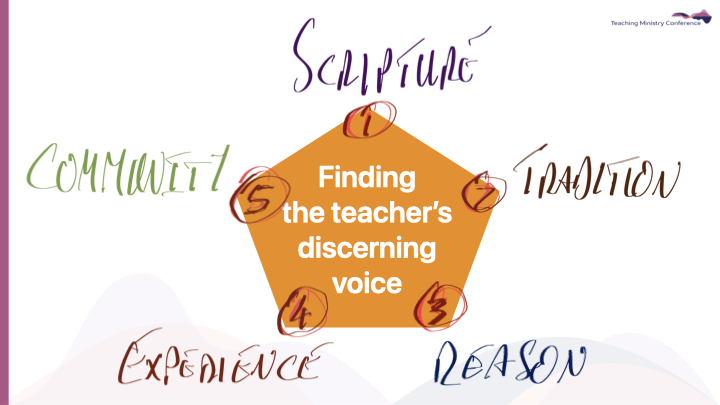
1. The Quintilateral Method. Instead of looking at a text in isolation, look through five lenses: Scripture (always primary), Tradition (2,000 years of Christian wisdom), Reason (your God-given brain), Experience (what happens when we live this out?), and Community (wrestling with the Word together).

2. The Discerning Voice Table
- Where Revelation is Clear: Speak confidently. Think of the basics of the Gospel in 1 Corinthians 15 or the warnings in Galatians 1:6-9.
- Where Revelation gives Principles: Teach wisdom (Acts 15:28) . This applies to things like how we use money, or handle dating.
- Where Revelation is Silent: Admit uncertainty. Whether it’s school choices, political voting, or when Jesus is coming back, sometimes we just don’t know.
Letting Scripture Set the Volume
Ultimately, our calling is to let God’s Word determine our volume. We must avoid extremes, as Ecclesiastes 7:18 says: “Whoever fears God will avoid all extremes”.

We must embrace the truth that “The secret things belong to the Lord our God, but the revealed things belong to us” (Deuteronomy 29:29). For now, we “see in a mirror, dimly,” but one day we will see face to face (1 Corinthians 13:12).
Where God speaks loudly, we must not whisper. Where God whispers, we must not shout. Where God is silent, we must not manufacture sound.
Discernment is not maximum certainty; it is faithful, loving, Christ-shaped teaching.
Your brother, Malcolm