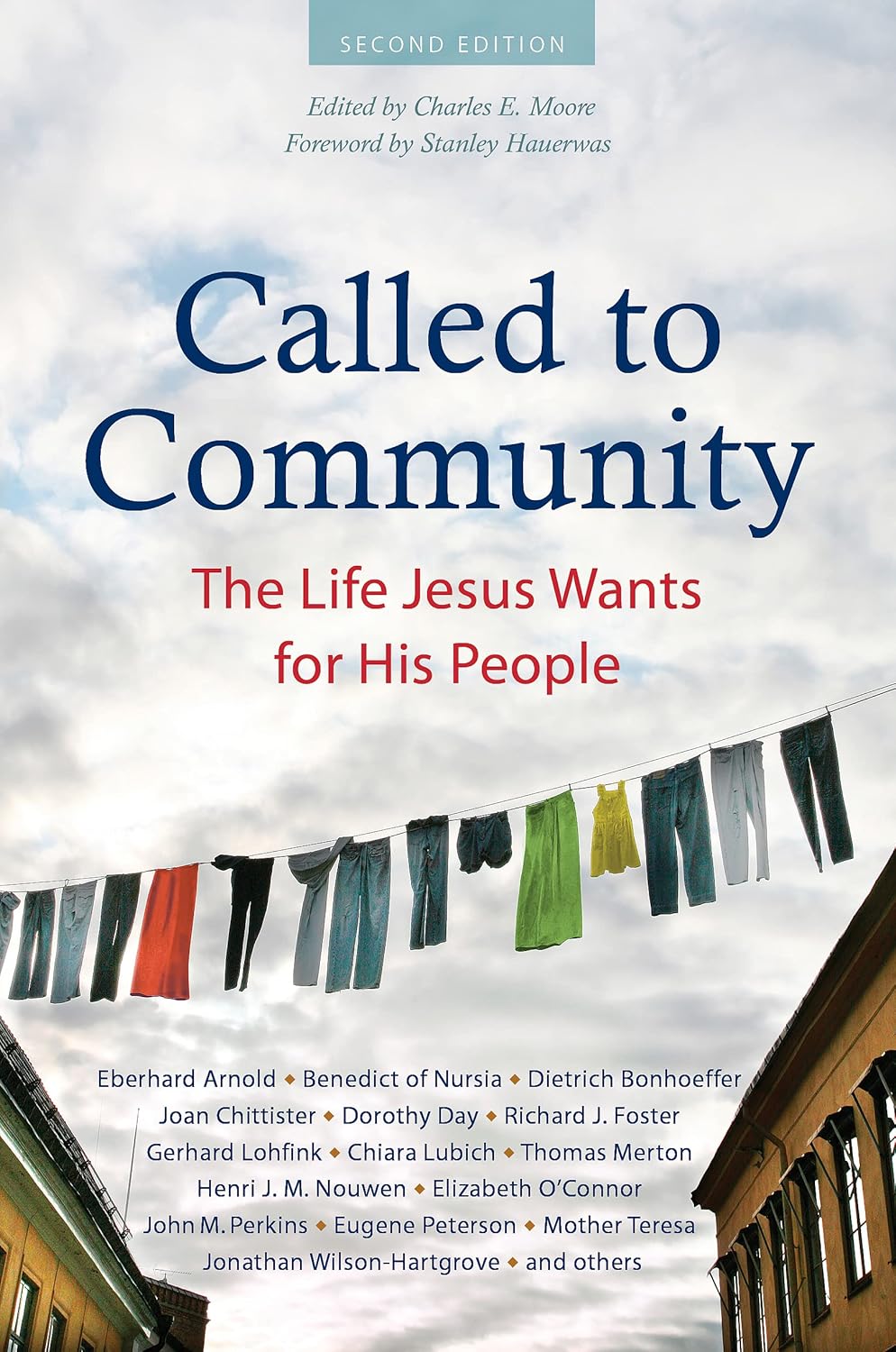
Thoughts inspired by a chapter in the book, Called to Community, page 18. Gerhard Lohfink.
Faith that takes flesh: Why Christian community must be embodied
What does it mean to be a community of faith? This question is on my mind because of recent events. Last Sunday, we celebrated 10 years as a congregation. The anniversary service was notable for the emphasis on community that various speakers placed on it. In their prayers, comments and testimonies, person after person spoke of how much they valued the community aspect of our church life. On Sunday, we reflected on many ways God has been at work amongst us this last decade, but perhaps what we celebrated most, other than God’s grace, was that he had put us into and moulded us into a community of faith. What does that mean?
These thoughts might help.
Last year, I read something in the book Called to Community that brought this into focus:
“It would be essential that they weave together all their gifts and opportunities…” (p.18)[^1]
What is the author’s meaning? He emphasises that faith, when it is truly Christian faith, does not remain isolated within individuals. It impinges upon the lives of others. And in doing so, it enriches both the giver and the receiver.
Faith tends toward embodiment
The author (Gerhard Lohfink) goes on to say:
“All this is part of the tendency of faith to embodiment.” (p.18)
That phrase—the tendency of faith to embodiment—is worth mulling over. In many Christian contexts, faith is treated primarily as something internal: a set of beliefs we hold, experiences we cherish, or convictions we articulate. While belief and experience are essential, they are incomplete on their own.
Christian faith, rooted in Jesus Christ, is never meant to remain vague, disembodied, or purely conceptual. At the heart of our faith is the incarnation:
“The Word became flesh and made his dwelling among us.” (John 1.14)
God did not save the world through ideas alone, but through a life lived in real places, among real people, with real needs. If we take Jesus seriously—his life, his teaching, his death, and resurrection—then our faith will inevitably move toward practical expression. Watching the series, “The Chosen“, as I have recently, brings this into sharp focus.[^2]
From private belief to shared life
This is where Christian community becomes essential. Faith that is not expressed in community risks becoming self-referential and inward-looking. But when faith is lived together, it becomes visible, tangible, and meaningful beyond itself.
The New Testament consistently links faith with shared life:
“They devoted themselves to the apostles’ teaching and to fellowship, to the breaking of bread and to prayer.” (Acts 2.42)
Notice how quickly belief moves into practice.
“All the believers were together and had everything in common. They sold property and possessions to give to anyone who had need.” (Acts 2.44–45)
This was not idealism; it was embodiment. Faith took flesh in the way believers related to one another.
Why the house church made embodied faith unavoidable
In the New Testament world, most churches met in homes.[^3] This setting made embodiment unavoidable in ways that modern church life often does not when we gather in large auditoria facing the front instead of one another.
In a house church:
- Needs were known and could not be ignored.
- Disputes surfaced quickly and had to be addressed.
- Sin became visible sooner rather than later.
- Doctrinal error swiftly affected the whole group.
Paul’s letters make far more sense when read with this context in mind. When he writes,
“If one part suffers, every part suffers with it; if one part is honoured, every part rejoices with it.” (1 Corinthians 12.26)
he is not offering a metaphor detached from reality. He is describing lived experience. In close-knit Christian community, you cannot suffer—or rejoice—alone.
This proximity could be uncomfortable, but it was also profoundly formative. Faith was tested, refined, and expressed through frequent interactions.
Gifts that overlap and enrich
The call to “weave together all their gifts and opportunities” points us back to another central New Testament theme: the body of Christ.
“Now you are the body of Christ, and each one of you is a part of it.” (1 Corinthians 12.27)
Spiritual gifts are not given for private fulfilment but for shared blessing:
“Each of you should use whatever gift you have received to serve others, as faithful stewards of God’s grace in its various forms.” (1 Peter 4.10)
When gifts overlap—when teaching and prayer meet practical help—faith becomes visible. The community itself becomes a testimony.
Love made credible through action
Jesus ties the credibility of the gospel not to correct doctrine alone, but to visible love:
“By this everyone will know that you are my disciples, if you love one another.” (John 13.35)
Love expressed practically—through generosity, patience, forgiveness, and service—binds a community together in ways that shared singing, praying, and learning cannot accomplish on their own. Those practices are vital, but they reach their fullness when they overflow into action (James 2.17).
Christian community is where faith finds its life.
A faith the world can recognise
If faith is to have meaning outside the church, it must first take shape within it. A community that embodies faith—imperfectly and honestly—offers the world something it cannot easily dismiss: a lived alternative.
This does not mean community is easy. It is often costly, messy, and humbling. But it is precisely there, in shared life, that faith becomes more than an idea. It becomes flesh again.
And perhaps that is the calling we face: Not merely to believe together, but to become together—so that faith may once more be seen, touched, and known.
Questions
I am grateful for the stimulating and challenging ideas contained in “Called to Community”. However, these comments leave me with as many questions as answers. Given that our 21st-century culture is so different socially, economically, religiously and in worldviews, how do we build, maintain and express our faith in community?
Let me know your thoughts.
Your brother, Malcolm
[^1]: Amazon link: https://amzn.eu/d/hfaGIss
[^2]: Link to The Chosen: https://watch.thechosen.tv/
[^3]: E.g. Philemon .2