
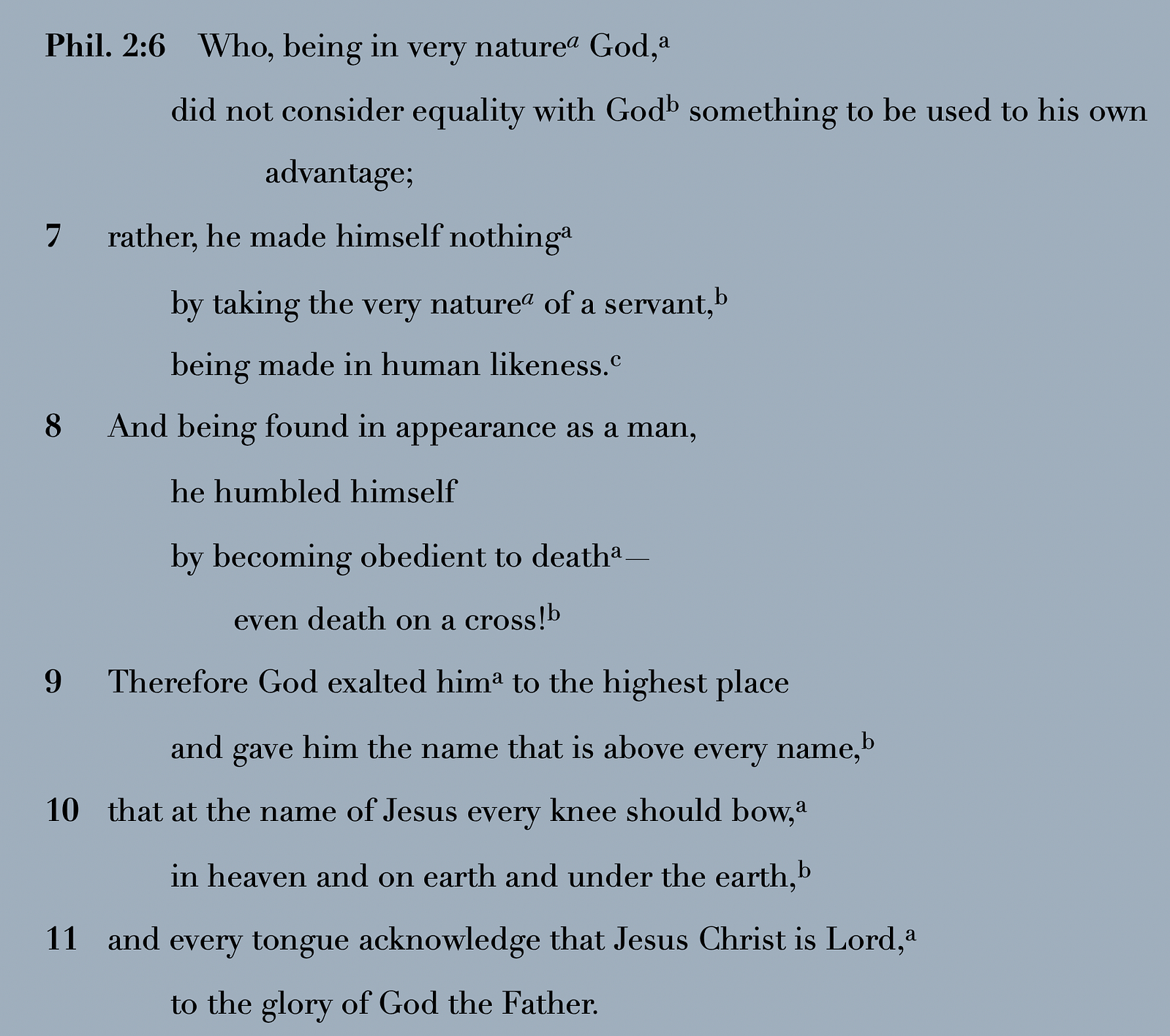
The majestic poetry of Philippians 2.6–11 was probably an early Christian hymn. It might even have been written by the apostle Paul himself. What is it telling us about Jesus?
“…who, though he was in the form of God, did not regard equality with God as something to be exploited,
but emptied himself, taking the form of a slave, being born in human likeness. And being found in human form, he humbled himself and became obedient to the point of death — even death on a cross.
Therefore God also highly exalted him and gave him the name that is above every name, so that at the name of Jesus every knee should bend, in heaven and on earth and under the earth, and every tongue should confess that Jesus Christ is Lord, to the glory of God the Father.” (Philippians 2:6–11 NRSV)
The first 3 verses tell us about his heart and the actions that followed. The next 3 reveal what God did as a result, and what all humans will do.
Fully Human, Fully Divine
One of the great mysteries of our faith, expressed in this passage, is how Jesus could be both fully human and fully divine. The Bible tell us that Jesus is God incarnate — the eternal God taking on human flesh. He was not partly God and partly man, but truly both at once. We see clear evidence of His divinity throughout the Gospels. Jesus was worshipped (John 9:38; John 20:28), and even His opponents recognised that He claimed to be God (John 8:58 59).
Jesus’ humanity meant He was “tempted in every way, just as we are” (Heb 4:15). As a human being, He knew what it meant to be tired, hungry, in pain, and even to face death. Jesus was made “in the likeness of sinful flesh” (Romans 8:3), sharing in our weakness while remaining without sin.
Yet there’s a tension here. Scripture also tells us that “God cannot be tempted by evil” (James 1:13). How, then, could Jesus — fully God — experience real temptation? Christians have wrestled with this throughout the ages. Two common views are as follows:
1. The Sinlessness View
This view holds that Jesus was without sin but was capable of sin. Under this option, Jesus possessed the capacity to sin but never realised it in action. This perspective aims to affirm that Jesus truly felt the “gravitational pull of temptation”.
2. The Impeccability View
This view maintains that Jesus was incapable of sinning. Someone who is impeccable is not merely sinless, but truly incapable of sinning under any circumstances. This view aligns well with the biblical claim that God cannot be tempted. To reconcile this with his genuine humanity, one possibility suggested is that Jesus’s human nature, though inherently capable of sinning like any other human nature, was prevented from sinning by being united to his divine nature. His divinity acts like foam packing wrapped around his ‘fragile’ human nature, rendering it incapable of sinning, even though he could still genuinely feel the fight and be affected by the punches of his opponent (temptations).
What do you think? How do you reconcile Jesus’ sinlessness with his humanity?
You might find this video interesting: “Did Jesus claim to be the Son of God?”: https://youtu.be/8dILdrXntPA?si=h7GnDMm08Kw2vNuq
Your brother, Malcolm