Rethinking Greatness in the Church
Introduction
We might think we know what “leadership” is. After all, we experience it all around us at work, in the home, sports, politics and church. However, do we really know what God thinks about leadership? How many assumptions remained unexamined? How does the Bible actually speak about leadership?
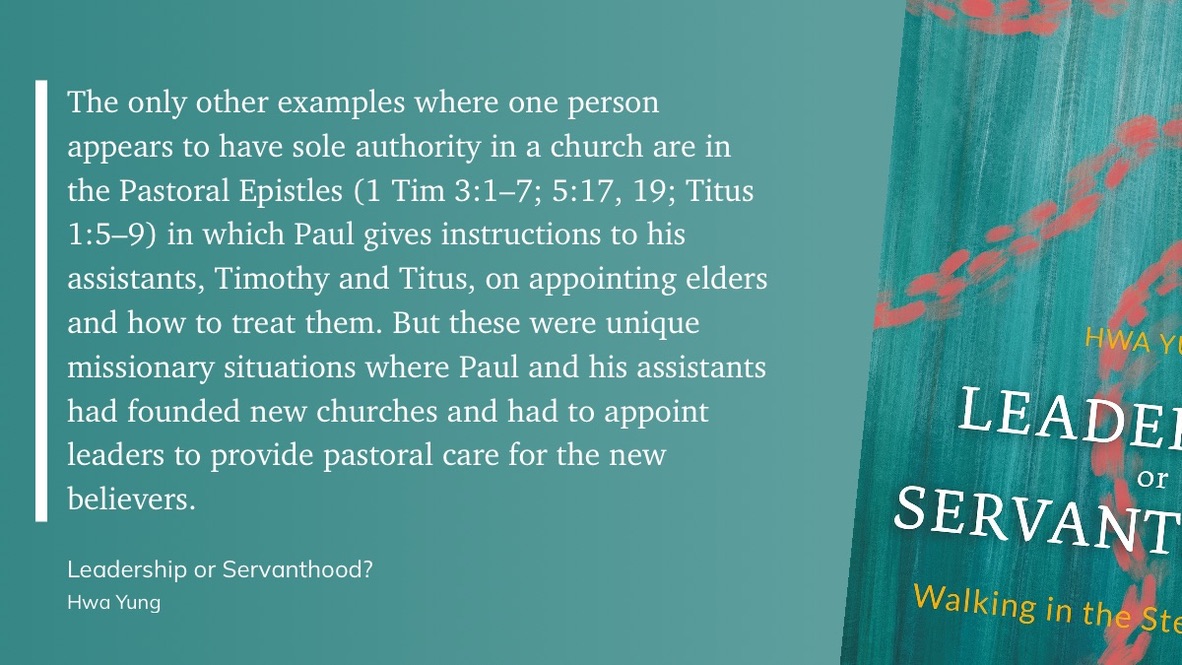
To help us with this question, I am drawing from Hwa Yung’s book, Leadership or Servanthood?
Message
“Whoever wants to become great among you must be your servant, and whoever wants to be first must be your slave — just as the Son of Man did not come to be served, but to serve, and to give his life as a ransom for many.” (Matt. 20:26–28)
Leadership is often equated with influence and achievement. The church has not been immune. Many church ministers are expected to act as CEOs, measuring ministry in terms of growth charts. But as Hwa points out, “the fundamental nature of the ministry and leadership to which they are called is defined by servanthood, and not by position, status, and power.”
Core idea: Christian leadership is a combination of leadership gifts (Rom 12.8) and a servant heart.
How are people with leadership gifts prepared?
Have you noticed that the Bible never commands us to train ‘leaders’? Doesn’t that seem odd? Why might that be? Yung observes, “It is clear that the primary emphasis in the New Testament is on the training and development of faithful and godly disciples. Nothing is mentioned about leadership development.” Perhaps the reason leaders are not ‘trained’ specifically to be ‘leaders’ is that it may awaken the selfish-ambition monster that lurks inside all of us. Instead, if we focus on developing all disciples in faithfulness, the leadership gifts carried by some will be used healthily.
Jesus (the most gifted and talented leader of all time) embodied the servant-first spirit. Though “in very nature God” (Phil. 2:6), he “made himself nothing by taking the very nature of a servant” (Phil. 2:7). His effectiveness came not from talent but from obedience to the Father (John 5.19). In a highly relatable way, the disciples struggled to grasp this. Luke 22:24 records that “a dispute arose among them as to which of them was considered to be greatest.” But they changed.
After the Cross-Resurrection-Pentecost events, Peter introduced himself not as “chief apostle” but simply, “Simon Peter, a servant and apostle of Jesus Christ” (2 Pet. 1:1). He urged church leaders to serve “not lording it over those entrusted to you, but being examples to the flock” (1 Pet. 5:3).
Jesus said, “The greatest among you will be your servant” (Matt. 23:11). People with the gift of leadership are no ‘greater’ than other disciples, but can be ‘greatly’ used by God if their ambition is to be the ‘greatest’ servant-disciple possible.
Reflection Questions
1. When you think of a “great” Christian, what picture comes to mind, and why?
2. How does Jesus’ example in Phil 2 challenge and inspire your own view of leadership?
3. In what ways can you practice servanthood in your life this week?
Closing Thought
Leadership in Christ’s church is never about status, but always about service. Let’s encourage one another to grow first as disciples — men and
women shaped by humility, obedience, and love.
God bless, Malcolm