Based on an article in Premier Christianity Magazine, September 2025, pages 56ff.
Introduction
How do you feel about zeal in the Christian life? I must admit to having a bit of a love/hate relationship with zeal. Some of that is related to past painful experiences. I vividly remember being asked by a church leader how I was. I said, “I’m fine.” His response was to rebuke me. I was told to “Get fired up!” Sometimes church leaders, including myself, have too often used zeal for God to justify riding roughshod over the weak. Sadly, zeal can be associated with spiritual bullying.
However, zeal is in Scripture, and it is a godly attribute. Can you and I redeem zeal from its connection with our traumas? This came to mind because of an article I read in Premier Christianity magazine. You will see the quote below. Let’s dive in and examine how passion can be blended with patience to create true spiritual maturity.
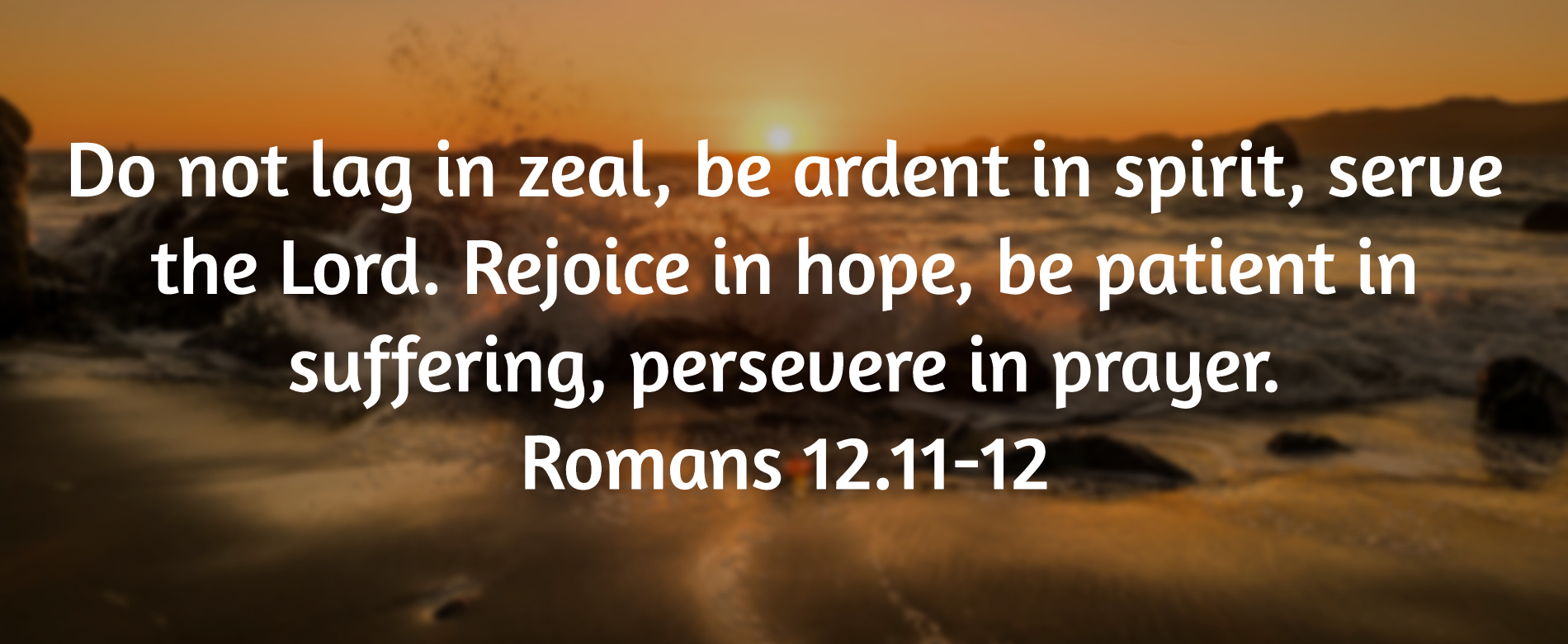
“Do not lag in zeal, be ardent in spirit, serve the Lord. Rejoice in hope, be patient in suffering, persevere in prayer.” Romans 12.11-12 (NRSV)
Zeal and the Spirit
Romans 12.11 urges believers to be “fervent in spirit” (NIV) and to serve the Lord with zeal. It is a strong command. God is not indifferent to half-hearted discipleship. He values passion, commitment, and energy directed toward him. “Keep your spiritual fervour” can also be translated as “be aglow with the Spirit.” The same Greek phrase appears in Acts 18.25, where Apollos is described as “fervent in spirit” (pneuma). This most likely refers to the Holy Spirit. That connection matters.
Zeal is not something we work up on our own. It’s something the Spirit produces in us. Our role is not to force ourselves into enthusiasm, but to cooperate with what God is already doing.
Zeal in context
Romans 12.11 does not stand alone. The very next verse, Romans 12.12, calls Christians to be joyful in hope, patient in affliction, and faithful in prayer. Zeal, in other words, must live alongside patience and perseverance. And not next door, but as a house-share.
As the writer in Premier Christianity Magazine puts it, “His call to zeal is tempered by his call to steadfast, faithful, long-range discipleship.” Zeal that burns hot but quickly fades is not the goal.
Healthy Zeal in the Old Testament
An inspiring (if scary) example of healthy zeal appears in [[Numbers 25.11]]. Phinehas acts decisively to stop sin that is threatening Israel’s relationship with God. His zeal is not impulsive self-expression. It is aligned with God’s holiness and preserves the covenant community. God commends it.
But Scripture also shows us what happens when zeal is not sustained by obedience and patience.
Saul: A Fast Start, a Weak Finish
King Saul begins well. In 1 Samuel 11, the Spirit of God rushes upon him. He acts decisively, rallies Israel, defeats the Ammonites, and even shows restraint by refusing to execute those who doubted him. At this point, Saul looks like a model leader.
The problem comes in 1 Samuel 13. Saul grows impatient while waiting for Samuel. Fearful of losing the people and eager to act, he offers the sacrifice himself. It looks zealous. It looks decisive. But it is disobedient. Samuel’s words are devastating. Saul’s kingdom will not endure. Obedience, not urgency, was what God required. Obedience is better than sacrifice, 1 Samuel 15.22.
Saul’s story reminds us that zeal is not the same thing as speed. Acting quickly does not always mean acting faithfully. When zeal outruns trust, the results are often damaging.
Misdirected Zeal
The New Testament echoes this warning. Paul openly admits that he was once intensely zealous, but dangerously misinformed (Acts 22.3). His passion led him to persecute the church. Likewise, Israel as a whole had zeal for God, but not according to knowledge (Romans 10.2).
Zeal, then, is morally neutral until it is rightly shaped. Passion needs truth, humility, and patience to become fruitful.
Jesus and Perfect Zeal
Jesus himself embodies true zeal. John 2.17 describes his passion for God’s house as something that “consumes” him. Yet his zeal never turns reckless or self-serving. He submits to the Father’s timing, embraces suffering, and walks steadily toward the cross.
Jesus shows us that holy zeal is not frantic. It is focused, obedient, and willing to wait.
Zeal That Endures
Romans 12.11 affirms zeal as a good and necessary thing. Romans 12.12 shows us how it survives. Patience, faithfulness, and prayer protect zeal from burning out or turning destructive.
“…so that you may not become sluggish, but imitators of those who through faith and patience inherit the promises.”” Hebrews 6.12 (NRSV)
The writer to the Hebrews urges believers to imitate those who through faith and patience inherit what has been promised. The blessings of zeal are harvested slowly. Without perseverance, passion often withers before it bears fruit.
Application: Blending Zeal and Patience
So how do we hold these together in our day-to-day discipleship?
- Check your motivations. Ask whether your urgency comes from trust in God or anxiety about control.
- Stay rooted in obedience. Enthusiasm never excuses ignoring God’s instructions, even when delay feels costly.
- Value slow faithfulness. Many acts of genuine zeal look ordinary. Showing up, praying consistently, serving without recognition.
- Submit plans to prayer. Patience develops when decisions are immersed in prayer rather than driven by pressure.
- Learn from long-haul believers. Seek out Christians who have followed Jesus faithfully for decades, not just those who make strong first impressions.
Zeal is most powerful when it is sustained, not rushed.
Conclusion
God does not ask us to choose between passion and perseverance. He calls us to both. Zeal matters. But zeal that lasts matters more.
The Christian life is not a sprint powered by adrenaline. It is a long walk shaped by faith, patience, and obedience. When zeal is blended with perseverance, it becomes a steady fire that warms others and honours God over the long run.
Clearly, much more could be said about this topic. What are your thoughts on the blending of zeal and patience? I’d love to hear from you.
Your brother, Malcolm